
Your Guide to Selling a Vehicle in Australia
Figuring out the best way to offload your old car can feel like a chore. The path you choose directly influences how much cash ends up in your pocket, how quickly the deal gets done, and how much of your time you'll invest — especially if your car is no longer roadworthy, has expensive mechanical issues, or is simply unwanted. The market also shapes your options: recent data for May 2025 showed that while overall new car sales in Australia dipped by 5.2%, SUVs kept flying out the door, making up over 60% of all sales, and a popular brand like Toyota was holding 19.9% of the market share.
Choosing your selling method
- Going private — your best bet for the highest price, but the most work: photos, ads, calls, test drives, and paperwork.
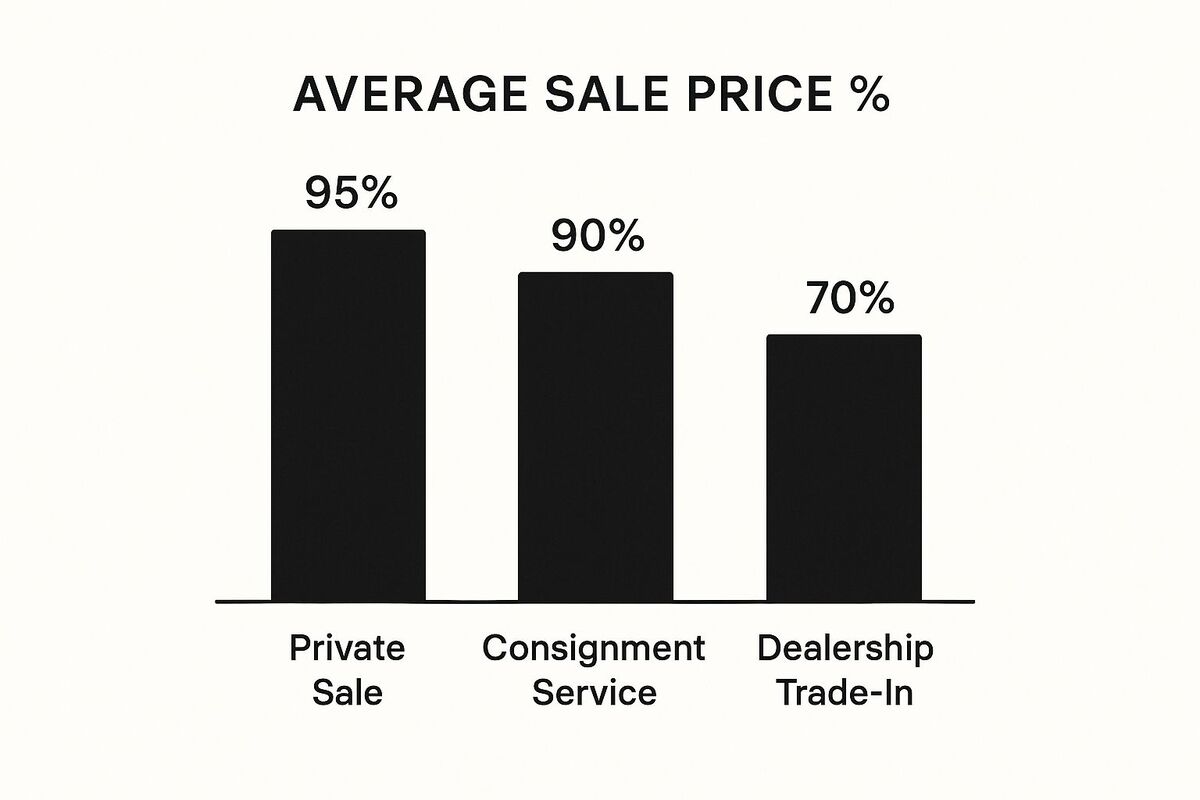
- Dealership trade-in — unbeatable convenience if you're buying your next car there, but you'll be offered less, sometimes significantly.
- Online car buyers & wreckers — the go-to for speed and simplicity, perfect for older, damaged, or deregistered vehicles, with a quick quote and removal handled for you.
About 70% of Australians now sell privately or through online buyers, while only 30% stick with dealership trade-ins — a clear trend towards methods that pay more or make life easier.
Getting Your Car Ready to Impress Buyers
Presentation is everything — a well-presented car communicates value and care, which translates to a better offer. You don't need a professional detailer:
- Make the exterior gleam — a wash and wax (which fills tiny scratches), and clean wheels and tyres.
- Tackle the interior — vacuum everywhere, wipe the dash and console, and clean the inside of the windows.
- Get rid of nasty smells — an odour neutraliser, or a box of baking soda left overnight.
A clean car sells faster and for more money. When a buyer sees a sparkling vehicle, it builds immediate trust and signals the car has been well cared for.
Then gather your logbook, service history, registration papers, and receipts for significant work in a single folder.

Pricing Your Vehicle to Sell
Setting the right price is the trickiest part. Search Carsales and Gumtree for your exact make, model, and year, paying closest attention to kilometres. A pro tip: if an ad has been up for weeks, it's probably overpriced; the ones that vanish in a couple of days are the sweet spot. Key value drivers:
- Kilometres on the clock — lower mileage usually means higher value.
- The real condition — note every ding and scratch; buyers will spot them anyway.
- Service history — a stamped logbook is gold and adds negotiating power.
- Desirable extras — sunroof, leather, premium sound can justify a higher price.

Choosing Your Best Selling Channel
It comes down to a classic trade-off: time versus money. Selling privately almost always gets the best price, but requires the most effort. If you go private, a standout ad is non-negotiable — shoot on a bright but overcast day, get every angle, and be upfront about the good and the bad.
A quick tip on test drives: always put your safety first. Meet in a busy, public place, take a photo of their driver's licence, and never let them go alone.
Trading in at a dealership is peak convenience but a lower price. Instant cash-for-cars services find their sweet spot with older models — a fair quote, free towing, and a stress-free way to offload a vehicle that might have mechanical problems or isn't roadworthy. Auto Removal Adelaide offers instant cash up to $8,999 and provides free, same-day removal. There is more on how that works over on our cash-for-cars process.
Finalising the Sale and Managing the Paperwork
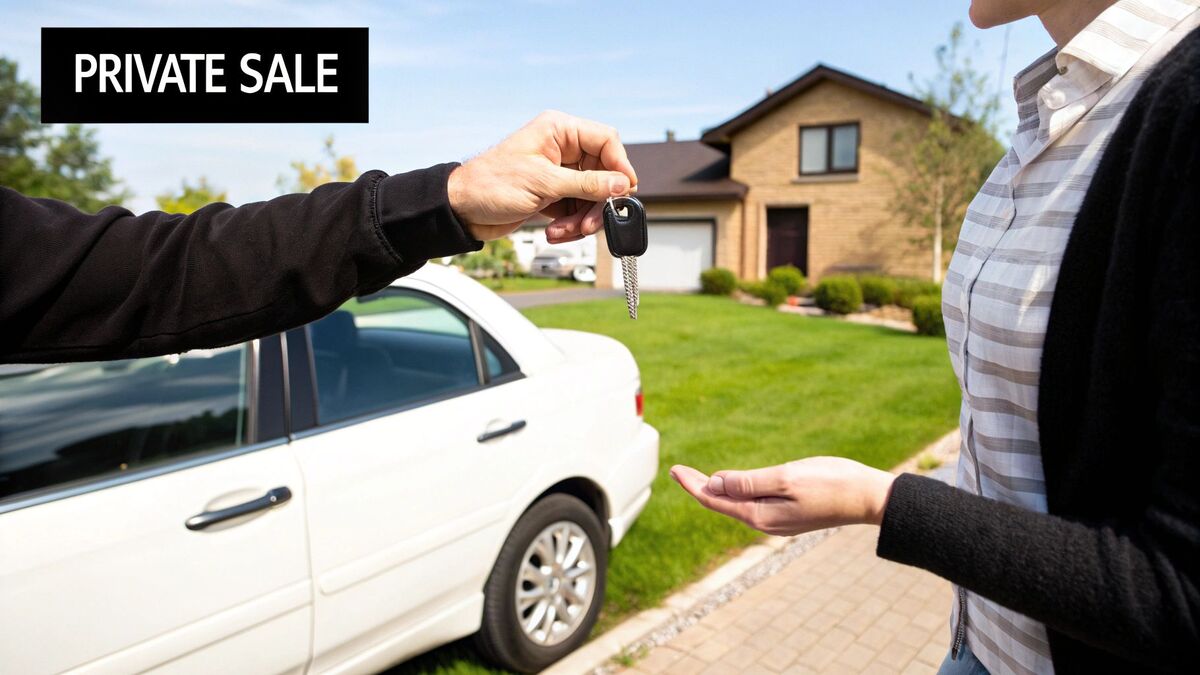
The deal isn't done until the money is cleared and the paperwork is sorted. To transfer ownership legally, fill out a Notice of Disposal and a registration transfer form — telling your transport authority the car isn't yours anymore. We publish our prices by make and model so you can see roughly where yours lands.
Securing payment safely
Never hand over keys or signed transfer papers until payment is securely in your account. A direct bank transfer (watch for cleared, not pending, funds) is usually safest; a bank cheque is solid if you watch the teller draw it up.
A classic scam: a buyer "accidentally" overpays with a dodgy cheque and asks you to refund the difference in cash. Always verify funds with your own bank.
A bill of sale should include both parties' names and addresses, the car's make, model, year, VIN, and registration number, the price and date, and a clear "as is, where is" statement. It pays to check our full range of car removal services before you commit to anything.
The Four Channels, Compared Honestly
Every selling route trades money against time and hassle. Knowing which trade-off you are making is most of the decision.
Private sale — most money, most work
You will typically clear the highest figure here, but you are taking on the advertising, the enquiries, the test drives, the negotiation and the payment risk. It suits a tidy, roadworthy car with service history and a realistic price. It suits a twenty-year-old car with a check-engine light very poorly.
Dealership trade-in — least money, least work
Convenient, immediate, and priced accordingly. A dealer has to recondition, warrant and re-sell the car, and their offer reflects that. Trade-in makes sense when you are buying from that dealer anyway and the paperwork happening in one visit has genuine value to you.
Online instant-offer services — speed with a spread
Upload details, get a figure, book an inspection. Fast and low-friction, but the offer is built to be resold at auction, so expect it to sit below private-sale money.
Cash for cars and wreckers — for cars past the point of repair
Once a car needs more work than it is worth, or it will not pass inspection, the private market disappears. This is the point where our Adelaide cash for cars service is usually the highest real offer available, because it is priced on parts and metal rather than on the car's ability to drive.
Writing a Listing That Actually Gets Answered
If you go the private route, the advert does most of the work. Twelve to twenty photographs in daylight, taken from every angle including the interior, the odometer, the engine bay and any damage you are disclosing. A description that states the year, variant, transmission, kilometres, service history, registration expiry and the reason you are selling.
Disclose the flaws yourself. A buyer who finds a fault you hid stops trusting everything else in the ad; a buyer who reads about it up front turns up expecting it.
Then handle enquiries safely: meet in a public place or at home with someone else present, photograph the buyer's licence before a test drive, confirm they are insured, and go along for the drive.
Where You Live Changes the Answer
Local market conditions genuinely shift what a channel is worth. Utes and 4WDs sell strongly and quickly across South Australia; small city hatchbacks move faster in the metro area than in regional towns; and anything needing specialist repair is harder to sell privately the further you are from a capital city.
Distance also affects cash offers — a buyer covering a long tow has less room in the price. You can see where that applies across our Adelaide service areas.
Top Questions About Selling Your Car
How long does it take to sell a car?
Private sales can take weeks or months; a trade-in is instant but lower-priced; an instant cash-for-cars service can have a deal done and the car gone within 24 to 48 hours. There is a lot more detail on that in our guide to the best way to sell a car in Australia.
Can I sell a car that's broken or damaged?
Absolutely — for car removal services and wreckers it's their bread and butter, buying for usable parts and scrap value, so condition is rarely a barrier.
What if I've lost the title or rego papers?
It's essential for a smooth private sale but not a deal-breaker for most car removal companies — they deal with it all the time and can walk you through proving ownership legally. Give us a call on 08 7113 2722 or book a free pickup, and we will sort the pickup around your schedule.
Is a roadworthy certificate compulsory?
In South Australia there is no general roadworthy requirement for a private used car sale between individuals, unlike some other states. You still must not misrepresent the car's condition, and a buyer will usually want an inspection.
Is it safe to accept a deposit?
Yes, if you put the terms in writing — the amount, what it holds, and whether it is refundable. Take it by bank transfer that has cleared, and give a written receipt.
What is the safest way to get paid?
A bank transfer you have confirmed as cleared in your own account, or cash counted in a bank branch. Avoid personal cheques and any payment that arrives with a request to refund part of it.
We offer competitive cash prices with on-the-spot payment and free towing anywhere in Adelaide.