
So, how much cash can you actually get for that old car rusting in your driveway? In Australia, the scrap car cost can be anywhere from $200 for a small, stripped-out vehicle to well over $1,500 if it's a heavier, complete car. What you're offered really boils down to three key things: the car's weight, the condition of its valuable parts, and what recycled metals are worth on the day.
What Determines Your Payout
When you're scrapping a car, stop thinking of it as a vehicle and start seeing it as a stockpile of valuable resources. A buyer isn't interested in its logbook — they're looking at its weight in steel, what parts can be salvaged, and whether it's all there. Three main things drive the quote:
- Vehicle weight and size: a hefty ute or large SUV has far more metal than a small hatchback — more metal equals more money.
- Completeness of the vehicle: a car that still has its engine, transmission, and catalytic converter is worth significantly more than a hollowed-out shell.
- Current scrap metal prices: the market is like the stock market — steel, aluminium, and copper prices rise and fall on global demand.
Beyond these, your make, model and year (some models have more in-demand parts), the condition of parts (usable alternators, wheels or seats add value), and your location (distance to the scrapyard affects towing costs) all play a part.
Why Weight Is the Biggest Factor in Your Payout
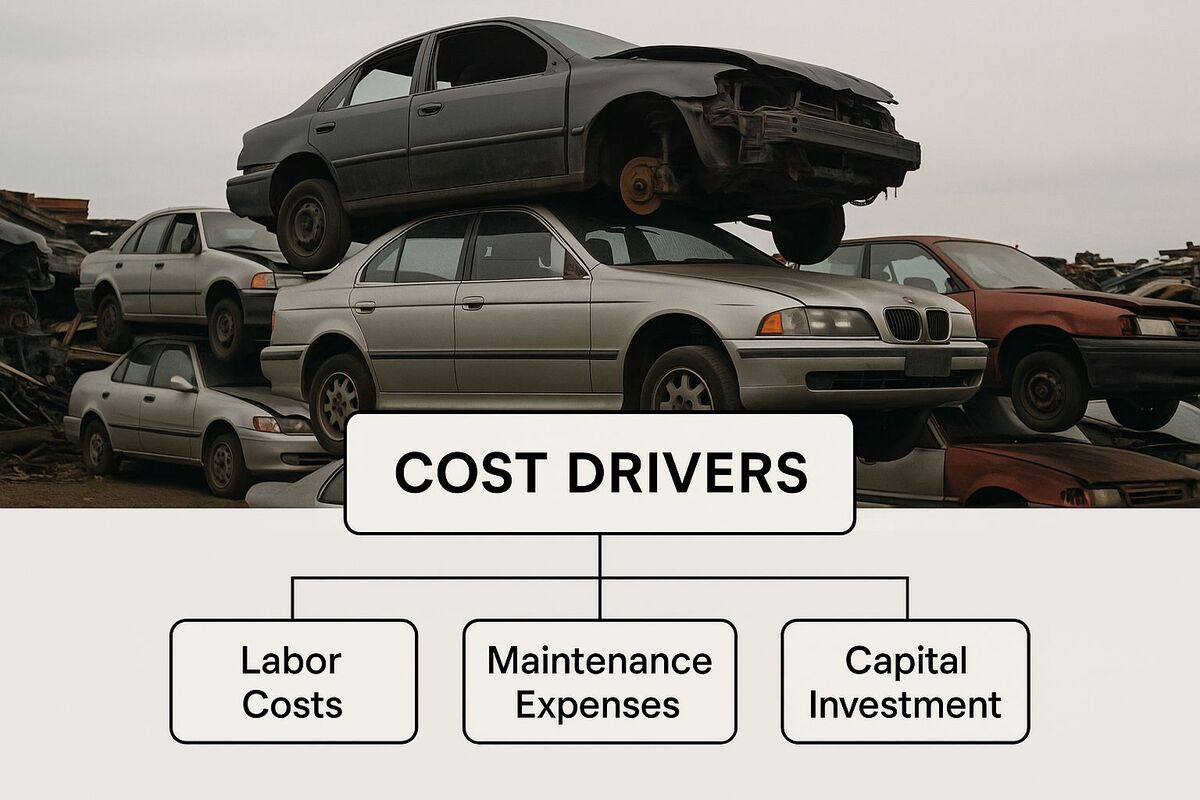
One thing matters more than anything else: your car's sheer weight. At the end of the day, your old car is a big pile of metal, and like any raw material, it's bought and sold by the kilo. A hefty Holden Commodore or Ford Falcon ute has a lot more steel and aluminium than a little Toyota Yaris. This "weighbridge value" is the baseline price wreckers work from. If that describes your car, this is the route most Adelaide owners take — see our scrap car buying service.
How make and model hint at weight
- Heavier vehicles command higher prices: SUVs, utes, vans and big sedans are built with more metal. A Mitsubishi Pajero outweighs a Suzuki Swift, which almost always means a better starting offer.
- Older cars can be heavier: cars from the 80s and 90s were often built like tanks with heavy steel frames, while modern cars use lighter alloys for fuel efficiency.
A car's weighbridge value is its most basic and important financial component. Everything else — from salvageable parts to market demand — builds upon this initial weight-based assessment.
How Global Markets Influence Your Local Quote
Ever wondered why the quote for your scrap car can change from one month to the next? The value of your old car is plugged into the global economy. Scrap metal is a global commodity, like coffee or oil, and its price fluctuates daily on supply and demand.
When manufacturing giants like China or India are in a construction boom, their demand for steel goes through the roof, driving up the price local scrapyards get — so they can offer you more. When global construction cools, the cash offer dips. If you would rather skip the guesswork, have a look at our auto wrecking operation — we can put a firm number on your vehicle in a couple of minutes.
Your end-of-life vehicle isn't just a local concern; it's a small but important cog in the worldwide supply chain for recycled materials. The quote you receive is a direct reflection of its current value on that international stage.
Australia is a significant player in the international scrap metal trade, with robust demand from industrial hubs like Malaysia, Vietnam, and India.
Does the Condition of Your Car Actually Matter?
It's a common misconception that once a car dies, its physical state doesn't matter for scrap value. While weight sets the base price, a complete vehicle is worth a lot more than a stripped-out shell — a wrecker is also a parts salvager. High-value components they hope to find:
- Engine and transmission — complex units packed with valuable metals and reusable parts.
- Catalytic converter — contains platinum and palladium.
- Alternators and starter motors — classic replacement parts.
- Clean interior parts — seats, dashboards, door panels.
- Wheels and tyres — a decent set of alloys with tread can sell on its own.
When you keep your car whole, you're selling a package of potentially reusable assets. A stripped car is literally only worth its weight in scrap metal.
The takeaway: don't strip your car for parts before you sell it to a wrecker, unless you're sure you can sell them for more yourself. Every component you pull off chips away at the final price. Around Adelaide, that is usually a job for cash for utes, vans and 4WDs.
More Than Just Cash: The Positive Ripple Effect
Recycling your old car packs a serious environmental punch. When you send your car to a professional recycler, you plug directly into the circular economy. In Australia, around 850,000 vehicles hit the end of the road each year, creating 1.36 million tonnes of waste; we recycle about 70%, and your choice nudges that number up. Working with a licensed recycler ensures:
- Safe fluid drainage — oil, coolant and brake fluid drained and disposed of correctly.
- Material recovery — up to 95% of a vehicle's materials are recoverable.
- Energy conservation — recycling steel slashes energy use by about 74% versus making it from raw ore.
What a Scrap Car Is Actually Worth, by Vehicle Type
Averages only take you so far, but they do give you a sanity check before you pick up the phone. Across Australia the typical scrap car lands somewhere around $500, and the spread either side of that is almost entirely about mass and salvageable parts.
Typical scrap payout ranges
- Small hatch or sedan (Mazda 2, Yaris, Barina): $200 – $450
- Mid-size sedan or wagon (Camry, Commodore, Falcon): $300 – $600
- Medium SUV or ute (RAV4, Hilux, Colorado): $400 – $700
- Large 4WD or van (LandCruiser, Patrol, HiAce): $500 – $1,000+
- Light commercial truck: $800 – $5,000+
A complete car with its engine, transmission and catalytic converter still fitted sits at the top of its bracket. Strip those out and you fall to the bottom of it — sometimes below it, because a shell missing its driveline is worth little more than its weighbridge ticket.
Why Two Identical Cars Get Different Offers
Location is the factor most people never think about. Distance costs money, and every kilometre of tow is deducted from what a yard can afford to pay you. A car sitting in a metro suburb is surrounded by competing buyers with short runs back to the yard; the same car three hours out of town is a half-day job for one truck.
The closer you are to a cluster of recycling yards, the more bargaining power you have — simply because more buyers can afford to quote on your car.
The used car market moves the number too. When second-hand prices are hot, fewer cars reach the yards and buyers lift offers to keep inventory coming in. When the market cools, as it did through 2025, scrapping becomes the sensible option for a lot of cars that would previously have been repaired and resold.
The Mistakes That Quietly Cost You Money
Most people lose value before the truck arrives, not during the negotiation. The four that come up again and again:
- Accepting the first quote. Ring at least three buyers. The spread between the highest and lowest offer on the same car is routinely 30–40%.
- Pulling parts out first. Selling the battery, alternator or good tyres separately can net a little extra, but every component you remove comes off the scrap offer — and a stripped car is worth less to a wrecker than a complete one.
- Not mentioning damage up front. A quote given on incomplete information gets revised on the driveway. Be straight about rust, missing panels or a seized engine and the price you are quoted is the price you get paid.
- Letting rust do its work. Heavy corrosion genuinely reduces the usable metal. A car parked on grass for five years is worth measurably less than the same car sold two years earlier.
One thing that does not matter: cosmetic damage. Dents, scratches, faded paint and a torn interior have almost no effect on a scrap valuation.
Got Questions? We've Got Answers
What paperwork do I need to have ready?
Two things: proof that you own the car (usually your registration certificate) and a valid photo ID like your driver's licence.
Is the towing genuinely free?
Almost always — the vast majority of professional services build free towing into the offer. Still, when getting a quote, just ask: "Is free towing included in that price?" If that applies to you, read up on how much car wreckers actually pay next.
Do I have to be there for the pickup?
It's the best way — you sign off the paperwork, hand over the keys, and get paid right there. If you absolutely can't make it, some companies allow other arrangements.
How fast do I get paid?
Almost instantly — in nearly every case you're paid cash on the spot the moment the tow truck driver hooks up your vehicle. The fastest way to find out what yours is worth is to call 08 7113 2722 or get an instant quote online with the make, model and rough condition.
Does my car need to be registered to scrap it?
No. Current registration and a roadworthy certificate are irrelevant to a scrap sale. What you do need is proof of ownership — the registration certificate or title in your name — plus photo ID.
Will I get more if the car still runs?
It depends who is buying. A pure scrap metal dealer pays on weight, so a running engine adds very little. An auto wrecker can resell a working engine, gearbox or alternator, so a runner is genuinely worth more to them. If your car still starts, get quotes from both.
Can I scrap a car that has been in an accident?
Yes, and it is one of the most common jobs we do. A written-off car still contains the same metal and often perfectly good parts on the undamaged side. Statutory write-offs simply need the correct paperwork lodged, which we handle.
How much does rust really affect the price?
Surface rust is not an issue. Structural rust that has eaten through floor pans, sills or chassis rails is, because it reduces the recoverable steel and makes the car harder to handle. Expect a noticeably lower offer on a badly corroded shell.
We offer competitive cash prices with on-the-spot payment and free towing anywhere in Adelaide.